 Nullvorm
Work / Case study
Flipside '86
A coin-flick roguelike in a neon 1986 casino, and how it got built. AI agents wrote the code. I designed the game and directed them.
- Role
- Pim Dieks: design and direction
- Year
- 2026
- Engine
- Unreal Engine 5.8, C++
- For
- Windows and Steam Deck
- Status
- In development
The bar
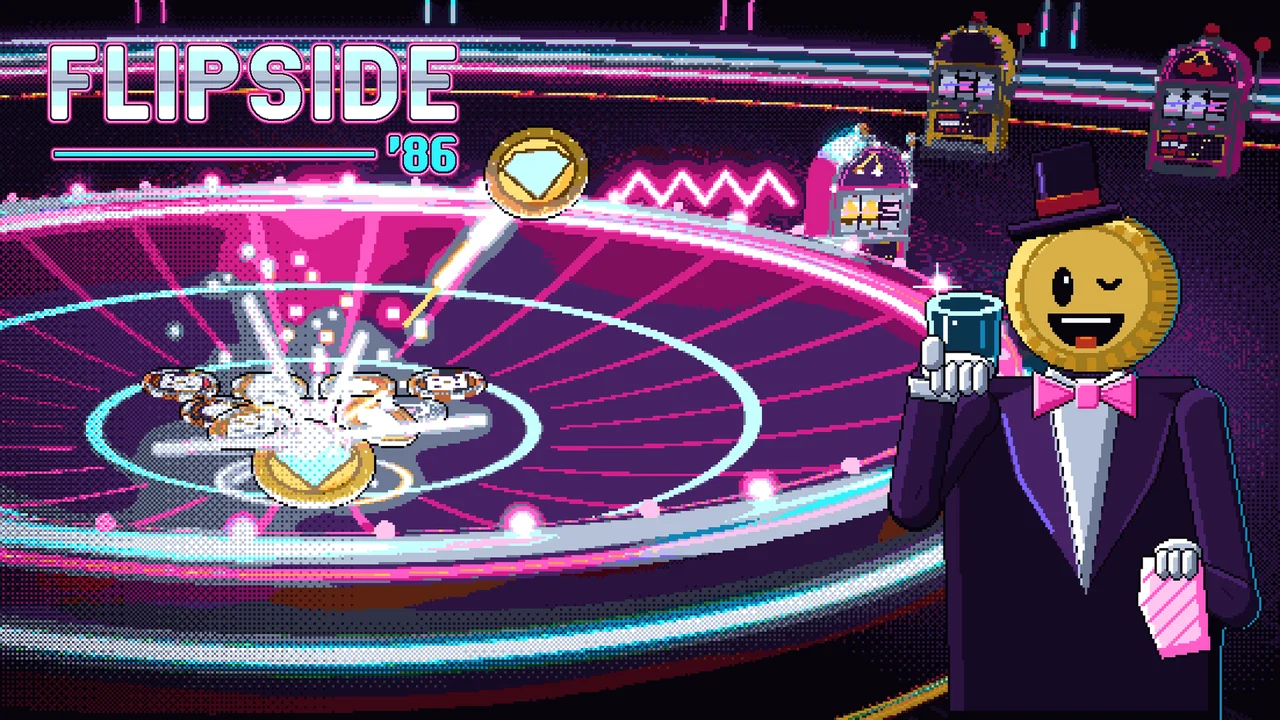
Flipside '86 is a roguelike about throwing coins. You clip a card on a coin, pull back like a slingshot and let it fly into a chrome bowl, and every coin stays in the bowl for the whole table. A run is 100 tables over ten floors. Above everything I set one bar: feel. A hit has to land with juice, and every coin has to stay readable while the bowl fills up with light and noise. All the money in it is pretend.
AI agents wrote the code, from the rules engine to the game in Unreal. I designed the game and directed them. This page is about how that worked.
Oracle and port
-
2.1The rules live in TypeScript
Flipside started on 27 September as a web game: a TypeScript rules core with a browser front end. The look I wanted needed Unreal, and balance work needed speed: a change to a coin's numbers should be tried on thousands of simulated runs without opening an engine. So on the first day I chose the split the rest of the build hangs on. The TypeScript core stays as the reference, the oracle, and the game gets a C++ port of it.
The oracle holds everything that decides a score: the random numbers, the coins, cards and combos, the floors, the physics, the scoring and the run itself. A balance bot plays it. When a change reaches every floor, 800 runs before are compared against 800 runs after.
-
2.2The port has to match, bit for bit
Goldens prove the port. A script plays seeded scenarios in TypeScript and writes down everything that comes out: where every coin ends up, each step of the tally, the shop offers, the payouts and the targets for all 100 tables. Tests in Unreal replay the same scenarios in C++ and compare. Even exp, cos and sin come from the same fdlibm routines the JavaScript engine uses, so a sine in the game is the same sine as in the oracle. A mismatch is a bug, never a judgement call.
The port has no actors and no rendering. It runs the rules and emits an ordered log of events.
One rules change, start to finish. The oracle is tuned on simulated runs, the goldens pin down what it does, and the port has to replay them exactly. -
2.3Deterministic physics, exact replays
For the goldens to hold, the physics has to give the same answer every time. So the coins run on a deterministic top-down simulation written for this game, with no part of the engine's own physics in it. The coins on screen only draw what the simulation says, and nothing on screen feeds back into the rules.
That is what makes a replay exact. The trailer is one real run: a bot found it in the oracle, the game replayed it table by table, and a check confirmed the score matched.
Every rules change takes the same road: TypeScript first, regenerate the goldens, then port to C++. The rules branch and the game branch land together in one push. Two slips on that road became rules. A script that imported the golden dump tool wrote new goldens as a side effect, and that went into the standard: a script that can write goldens refuses unless a switch asks for it. And the game's folder carries its own copy of the oracle; once an export ran from a stale copy and looked like the port had drifted. The export now prints a marker that names the oracle it used.
Agents in parallel lanes
-
3.1One lane, one worktree, one owner
I ran the agents as a team. One main session plans, splits the work into lanes and judges what comes back, and it doesn't build anything itself. A lane is one piece of work on its own git branch, in its own worktree: a separate folder with its own checkout, so one agent's half-finished code never ends up in another's build. In mid November four lanes were open at once: the fixes from a full audit, the coins, new art assets, and a change to the rules core.
Each lane has one owner. Unreal adds a hard limit: one process builds or runs the game per worktree, and a lock file says who holds it. A line that starts with
pim-playmeans I'm playing. Agents never delete another holder's lock and never kill my game. Agents working in the same repo commit with explicit paths, so nobody commits another lane's files by accident.In November I wrote these rules down as a standard for every Unreal game I make, each rule with the project that taught it, and Flipside taught several. The hot-zone rule is part of that standard: a file that almost every feature touches has one lane at a time.
The lanes come from the plan, and from sweeps. Every so often the whole game gets one: technical, security, design and UX audits run over all of it, and the findings become lanes. The sweep of 14 November brought crash-safe saves, a fix for a controller that disconnects and clearer screens on Steam Deck, and started the one menu system in 7.5.
The life of a lane. Every step has an owner and a check, and the way back to the brief is part of the plan. -
3.2The cheapest model that fits, more only on evidence
Every dispatch names its model and says why. Haiku runs mechanical work: suites, captures, file moves. Sonnet, the default, builds what is well specified. Opus gets craft and new diagnosis, and only with a one-line reason. Above Opus there is one more tier, for work that failed twice there or that I rejected more than once, one problem per agent. The first plan already worked this way: the C++ port and the table were Opus tasks, the audio and the soak bot Sonnet.
A task moves up one step only on evidence: two failed tries, a bug with no known cause, or a call that needs taste. The moment the work turns into runs, merges or waiting, it drops back to a cheap agent with a handover note. Nothing waits on an expensive model.
-
3.3The builder never reviews its own work
Every task gets separate reviewers: one checks the work against the spec, a second checks the quality of the code. And because everything in the game is original work, the names of other games and brands are grepped for before any output is accepted.
-
3.4A check must tell "worked" from "silently did nothing"
This is the rule I repeat most, and Flipside taught it the hard way. The game's 624 music stems are imported into Unreal per checkout, and the imported files are kept out of git, so a fresh worktree doesn't have them. Releases 0.1.5 to 0.1.9 went out without the floor themes, and a package without them plays the same table track on every floor. Nothing failed. Now the package script imports the music first, fails unless every stem is there, and after the cook lists the package and counts them again.
So the test harnesses are judged by markers in their logs, never by exit code alone, and a missing log counts as a fail. I read the real logs instead of an agent's summary of them. Every agent shows me something I can look at, an image, a video or a sheet, at least every 45 minutes. After two failed tries it stops and reports.
Judging what tests can't
-
4.1Captures, on sheets
Goldens prove the rules. They can't tell me whether a hit feels good or a coin reads at bowl size. That part runs on captures and on my eyes.
Captures come from the game's own harnesses: one for the table, one for the screens, one for every venue with its feature in play, and more for audio, long soak runs and video clips. The standard is one capture runner per game; a lane adds shots to it and never writes its own. What comes out is a contact sheet, so a whole round can be judged on one page.
Judging has an order. The main session looks at every sheet itself, on 3x crops, before I see it, and an agent's own grade is an input, never a pass. For the art, an independent critic ranks what falls below the benchmarks: the coins, the slot machine, the bar screen, Pinball Palace and the logo. Then it's my call.
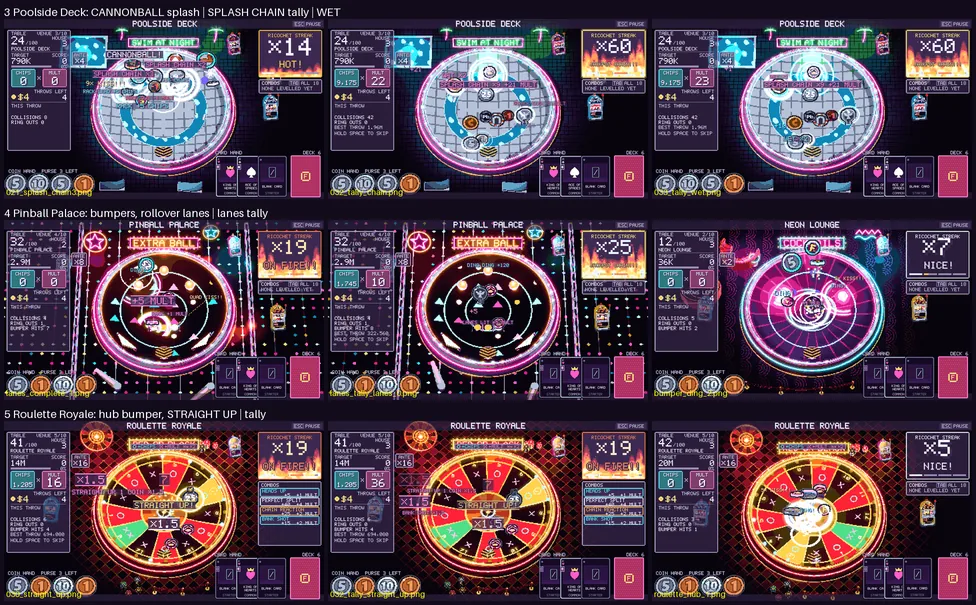
Part of a sheet from the art audit in November: per floor, the feature in play, then its tally. In the roulette row STRAIGHT UP is still gold and x1.5 white. The audit turned that into one rule for every callout: the feature word white, the multiplier pink, gold only for money. -
4.2Look and feel are mine
I judge look and feel by playing. Agents package a development build for me with a launcher per floor, each starting at that floor's first table with the coins and cards a real winning run held there, so I can play floor seven without first playing sixty tables. On 14 November I played the build from the full sweep and made three calls in one sitting: the middle spinner setting became the default, thirteen buffed coins and cards stayed, and the look of the sweep was accepted.
When a check fails on a design number, it comes to me as numbers. SLAM DUNK, the helicopter's payout, was tried at x2, x1.75 and x1.5, and none passed its gate as first measured. I chose x1.5, and the gate was changed to measure the lift on the same throws. Pay calls are mine. Agents show me the numbers and don't retune quietly.
Some calls no number makes. After the second helicopter I said: "I do not like the way the helicopter interacts with the bowl and the coins." The third one is a hook that catches your coin in the air and slams it down where it was going to land, and it never costs you a coin.
Finishing and shipping
-
5.1Freeze, and a finite road to 1.0
Once the core worked, new work tracks kept opening. On 28 September I told the agents they kept going in circles, and froze the features. The plan got a list to 1.0: ten items, each with an owner and a line that says when it's done. Anything new is a bug fix or waits until after launch, and each agent gets one item and stops. Later I made three exceptions myself: the floor reworks, the third helicopter and new marketing.
docs/PLAN.md, excerpt, shortened
ROAD TO 1.0 (FEATURE FREEZE, Pim 2026-09-28: "finish the game")
No new features, and no polish tracks. Every open item is below. When this list is empty, the game is done and goes to Steam. Anything else found is a bug fix, or it waits in the post-1.0 backlog at the bottom of this file.
# Item Owner Done when R1 Mythic art in game (spectrum rim, 30 emblems/icons, real colour) art agent in-game captures match the concept; tests green R2 Table: dev text hidden in normal play, clean-shot mode, dash strings, ACCESS options work on the table table agent clean build + harnesses green R3 Full-run soak, tables 1 to 110, forced Mythics menu agent no crash, softlock, overflow or save mismatch; bugs fixed R4 24 achievement icons (+ locked) Lucky artist sheet reads at 32 px R5 Min-spec helper merges + Shipping/Development packages, DX12/DX11 smoke min-spec agent packages smoke OK R6 Store screenshots 1 to 5 re-captured clean on the final build art agent (after R1, R2) 5 clean 1920×1080 shots R7 Quiet-window perf matrix, docs/PERF.md, Steam system requirements min-spec agent (after R5) min/recommended specs on the store page R8 Release candidate: Shipping package of main after R1 to R7, installed for Pim to play start to finish coordinator Pim plays it The first eight of the ten items on the list to 1.0. Every item has one owner and a test for done. The last two were steps only I could take. -
5.2Written release steps, and a standing go
A release follows written steps. Push the rules and game branches together and wait for CI on a self-hosted runner, about ten minutes. A release agent works from a brief copied from the last one. It builds from the pushed code in a fresh worktree, runs the release script as a dry run with every automated test, imports the music, smoke-tests the package on DirectX 12 and 11, builds the installer, writes the release log, commits "Release x.y.z" and tags it. Agents never install anything on my PC.
I approved releases 0.1.12 to 0.1.15 one by one. When the question came again for 0.1.16, I said "continue". Since then a green floor rework ships without asking. Design and pay calls still come to me, and any failed check stops the line. Between 1 October and 15 November there were 21 tagged releases, seven of them between 8 and 10 October.
docs/RELEASE.md, excerpt
v0.1.22 (2026-10-24): Shipping 289.0 MB (302,996,217 bytes, 25 files;
steam\release.ps1 -DryRun -Bump nonegreen with 140Flipside.*tests and the packaged smoke on D3D12 and D3D11), installerFlipside86_Setup_0.1.22.exe167.9 MB (176,021,125 bytes). Built from31a751dc(origin/main) with the version set to 0.1.22, which the "Release 0.1.22" commit after it records. The music check passed as in 0.1.10:FS_MUSIC_ASSETS ok=624 missing=0before the cook andFS_PACKAGE_MUSIC ok=624 missing=0on the container after it. What is new for players:- The Skyline helicopter's hook catches more. The hook now grabs any coin you throw that is still in the air, so heavy coins like the quarter can be slammed too.
- SLAM DUNK now pays x1.5 (it was x2), because the slam comes much more often now.
- A slam dunk hits harder. A ripple rolls through the whole bowl, the felt bends, every coin and chip bobs and the rim lights up as the wave arrives, with a deeper boom and more shake.
- The hook hangs below the helicopter instead of looking like it sits on its roof.
- Saves from 0.1.21 load as before.
The dev hooks stay off in Shipping as in the earlier entries: the smoke output (both RHIs) shows no
FS_CLIPWALK,FS_POPUP_SAFE,FS_CLEAN_CAPTURE,FS_RUN_TABLE,FS_RUN_LOAD[…]One entry from the release log: the size, the test count, the commit it was built from, the music counted inside the finished package, what's new for players, and the check that the dev hooks are off. The test count grew with the game: 94 at 0.1.3, 179 at 0.1.23. -
5.3Balance checks stay scoped
A full balance set over 100 tables costs hours of CPU and a lot of tokens. So when a change touches one floor, the test starts from saved run states at that floor's first table and plays only its tables, against a twin of the same floor with the new system switched off. The goldens already show the earlier tables didn't move. Only a change that reaches every floor gets the 800 against 800 runs.
-
5.4Every failure becomes a written rule
Every mistake I correct becomes a written rule the same day, and the guard goes into the brief that would have stopped it. Flipside has a page of them. A development build once crashed on a bug that both the editor and the final build hid, so every development build now gets a controller walk through every screen before it reaches me. An audit agent once deleted untracked files to tidy up, so every brief now says: never delete untracked files you didn't create.
In November those rules, with the ones from my other games, became one standard for every Unreal project I start. It begins with the split from chapter 02: keep the rules of the game in a pure module with no engine code, and let the scene draw what the rules say.
Who does what
Taste and the final say stay with me, checking goes to plain code wherever it can, and the agents do the volume: planning the work, writing it and reviewing each other.
- MeBrainstorms the design and approves the spec and the mocks.
- AgentsThe main session writes the plan, splits it into lanes and picks a model for each.
- AgentsBuilders write the rules in TypeScript, then port them to C++ in the game.
- Plain codeReplays every golden against the port, and captures every venue. Each harness is judged by its log markers.
- AgentsSeparate reviewers check the spec, then the code. A critic ranks the art.
- MePlays the build, judges the captures, and decides the look and the pay values.
- Plain codeCI builds it. A release goes out only when every check is green.
The design
All of that served a design. For background, these are the decisions the build had to hold.
-
7.1A 1986 casino flyer, on a 270-line grid
The art direction is a casino flyer: hard neon on purple-black, chrome coins that glint, chunky bloom. The palette is my own neon set. Everything is drawn on a pixel grid of 270 lines at 1080p, so one game pixel is four screen pixels, and a CRT pass on top adds the glass. The menus have their own grid, 640 by 360 drawn three times over, with five text sizes: 21, 28, 42, 56 and 70 pixels.
Colour has a job. In every floor callout the feature word is white, the multiplier pink and the chips cyan, and gold is kept for money and reward. A player learns that once and then reads it everywhere.
- Feature word
- Multiplier
- Chips
- Money and reward
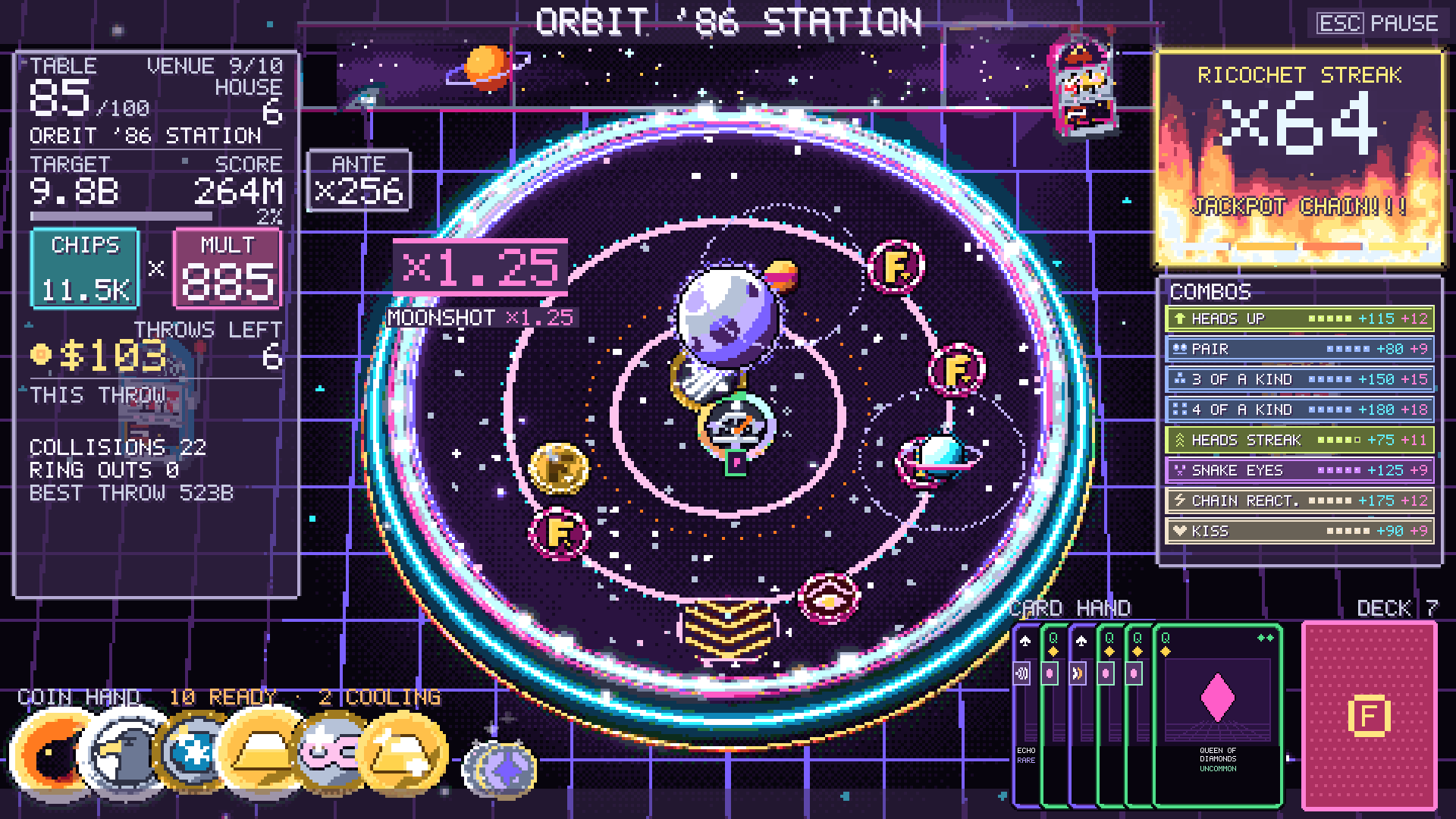

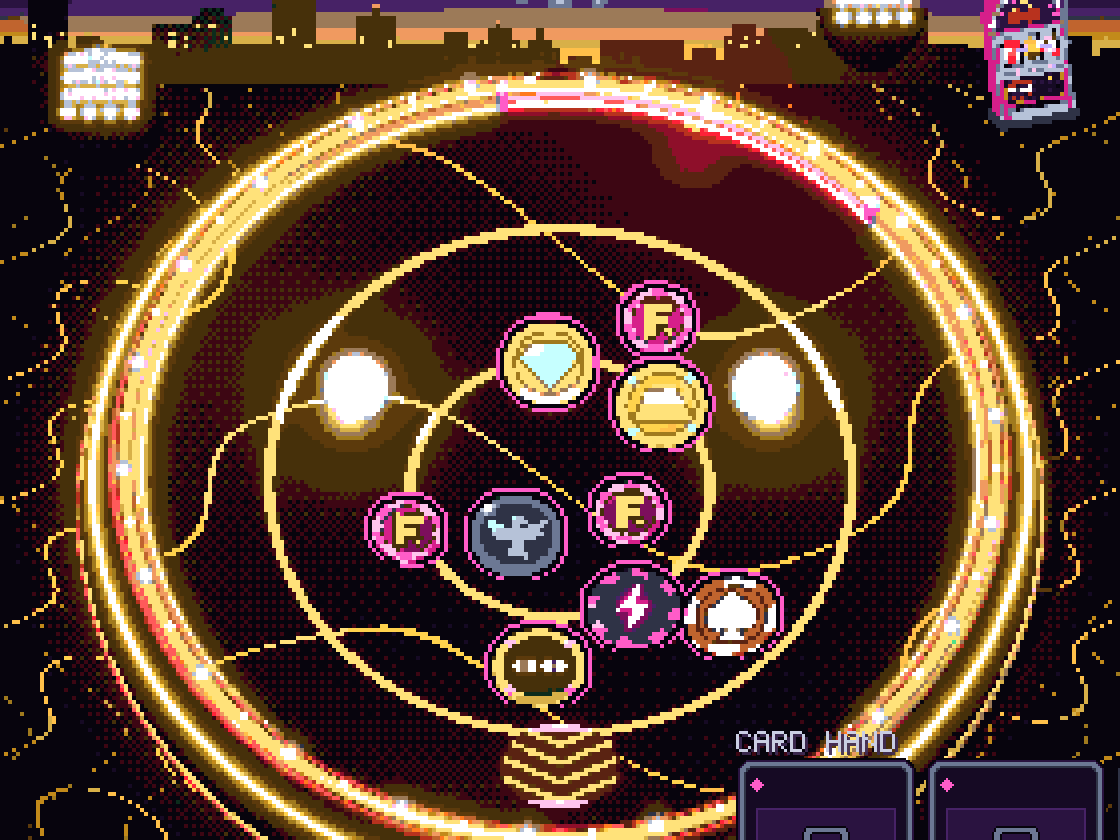
Orbit '86 Station, table 85: a planet hit pays MOONSHOT x1.25. With it, a crop of the same frame enlarged, where the pixel grid and the CRT pass show. -
7.2Coins come first
In a full bowl the coins are what the player reads, so they win over everything else on screen. Nothing decorative draws over a coin: no rotor smear, no splash, no light beam. The card row and the coin hand may cover the bowl's trim, never its rim or the play area. The side panels are see-through glass, so the room stays in view without crowding the bowl.
For the coins themselves I kept one criterion: how legible they are at bowl size, in play. The emblem is the largest, highest-contrast thing on a calm field, and any shading, bevel or glint that costs it clarity is reduced or dropped. Rarity lives inside the round coin, in its rim: plain for Common and Uncommon, a reeded ring for Rare, a gold beaded rim for Legendary and a six-tint rim for Mythic. I tried jagged outlines for rarity and rejected them.
Every coin change has the same test: no coin may read worse than before. In the first pass two coins lost clarity, so from then on good emblems kept their drawing, only weak ones were redrawn, and each was checked at 1x before and after.
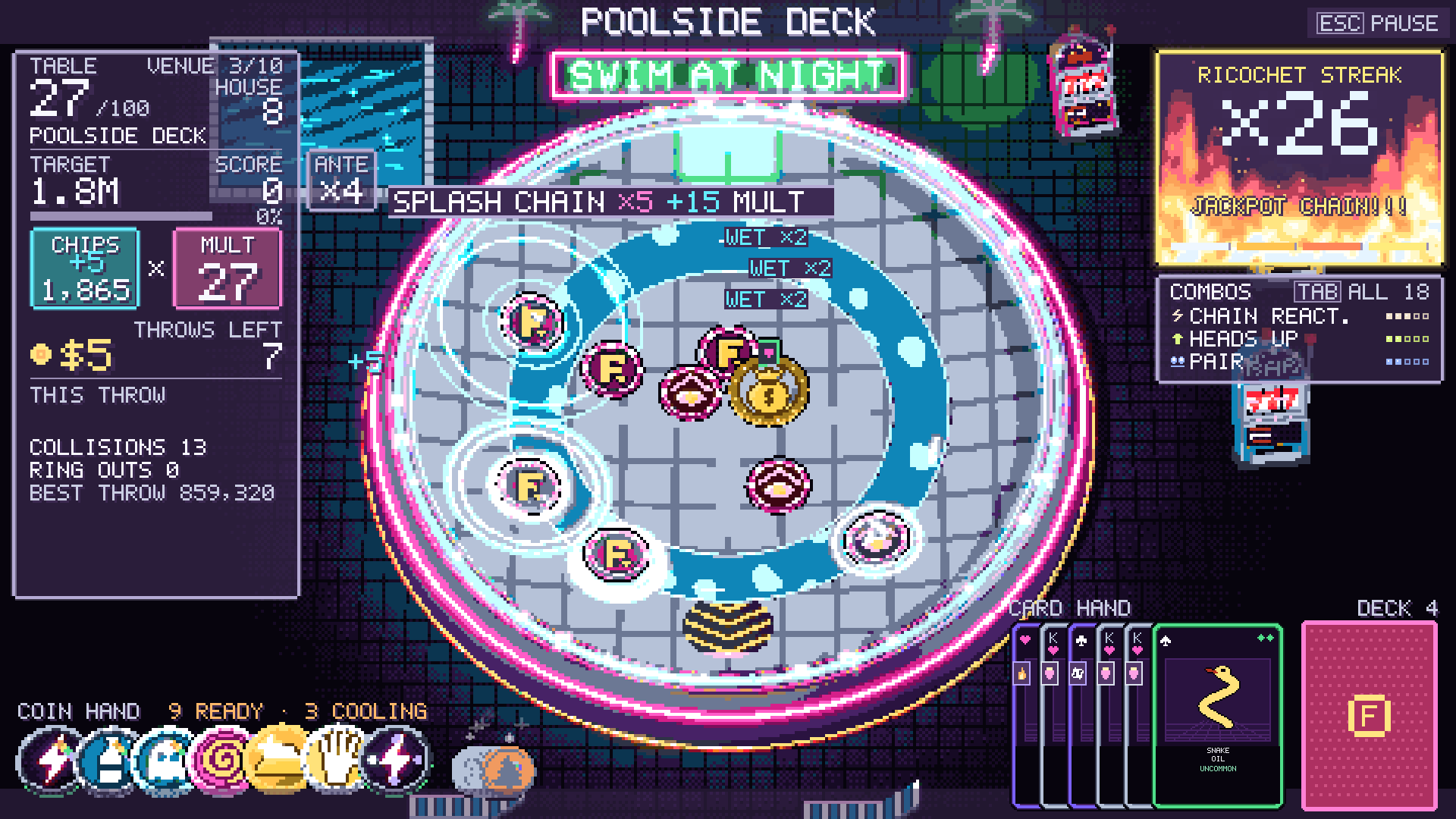
The Poolside Deck, table 27, mid SPLASH CHAIN. Drops and rings stay outside 0.76 of each coin's drawn radius, so the water never reaches an emblem. -
7.3Feel you can hear
Juice is how a hit tells you it mattered. Every hit feeds the Ricochet Streak, and every step climbs a semitone. NICE! at 5. HOT! at 10, when the meter catches fire and the music kicks in. ON FIRE!! at 15, with the siren. At 20, JACKPOT CHAIN!!!: slow motion on the next hit, and every slot machine in the room slams 7-7-7.
Big moments get a big treatment and small ones stay quiet. Combos come in three weights: everyday combos are quiet rows on the sign, good ones get a plated callout, and big ones get a count, a 0.15 second freeze, a banner and then the result. Floors with targets pay out in light and sound, with Pinball Palace as the benchmark. Popups stack in one staggered column, never on top of a coin.
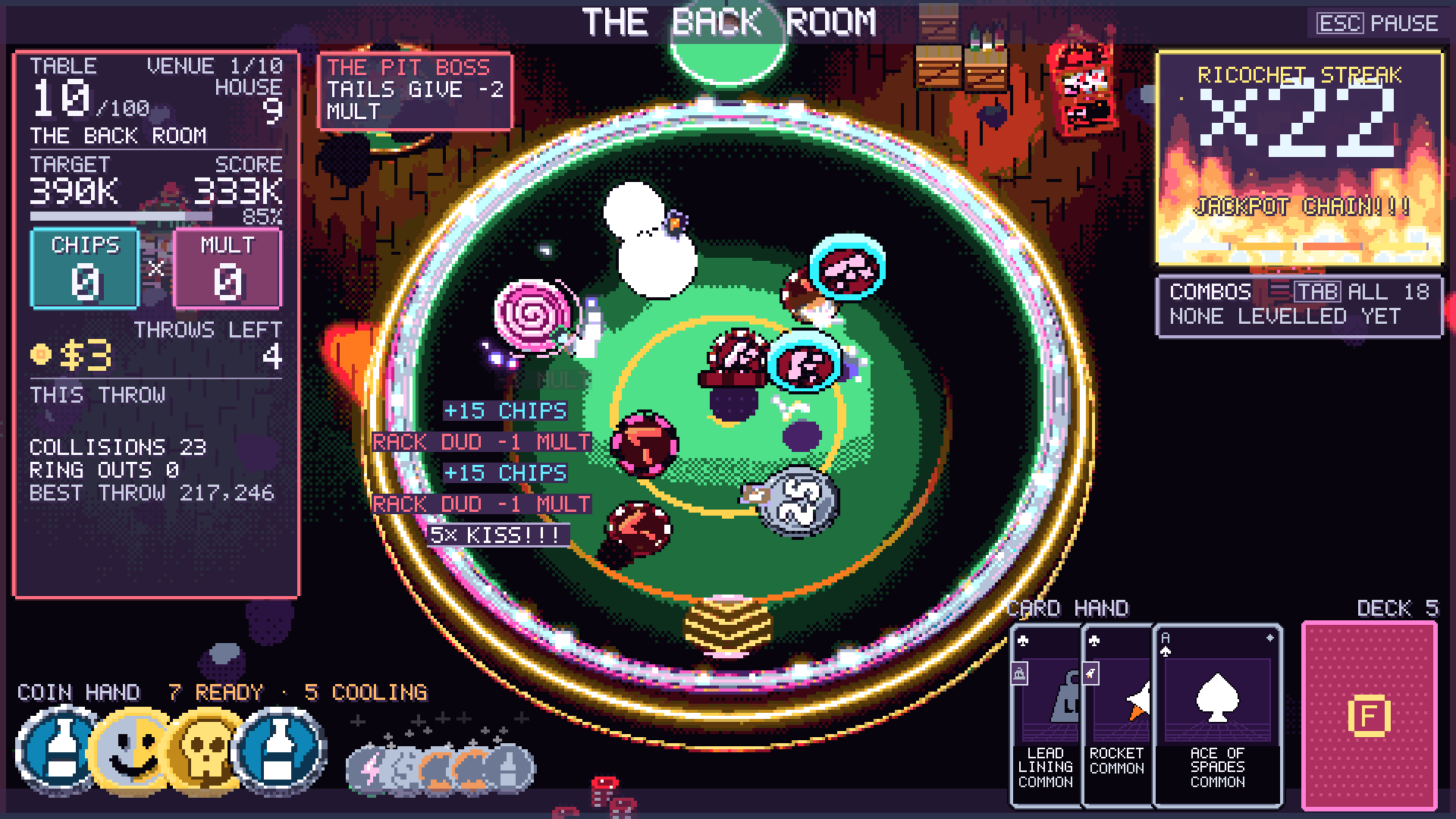
The Back Room, table 10, against the Pit Boss. The streak meter is on fire at x22. -
7.4Ten floors, one idea each
A run climbs ten floors of ten tables, and every floor after the first adds one piece of physics: pop bumpers in the Neon Lounge, a pool whose splash shoves coins on the Poolside Deck, a spinning roulette floor, a row of marching pixel invaders, a vault with a gold core, a helicopter that slams your coin down, low gravity and planets aboard Orbit '86. A boss waits on the tenth table of every floor, and THE HOUSE waits at table 100.
Each floor's neon is its identity: the pink and cyan grids, the water, the helicopter's body. The props had to reach the bar of the coins and the slot machines. They started as meshes without outlines that read as blobs, so I had them redrawn as pixel art in the palette, with a dark outline and a ramp of three to five steps.
The floors also pay by one rule. A one-off bonus such as SLAM DUNK or STRAIGHT UP pays for the thrown coin only, and bumpers, kickers and splashes pay for every coin that hits them. A floor mechanic never loses you a coin.
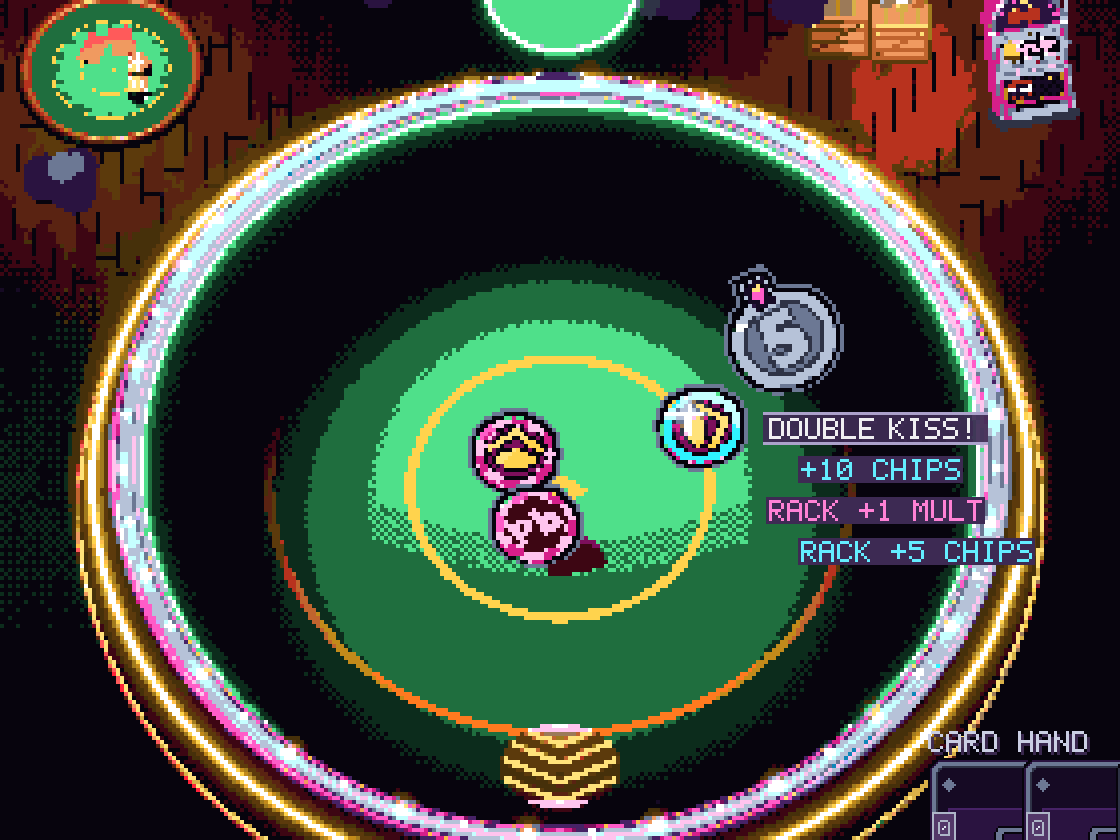 01The Back Room
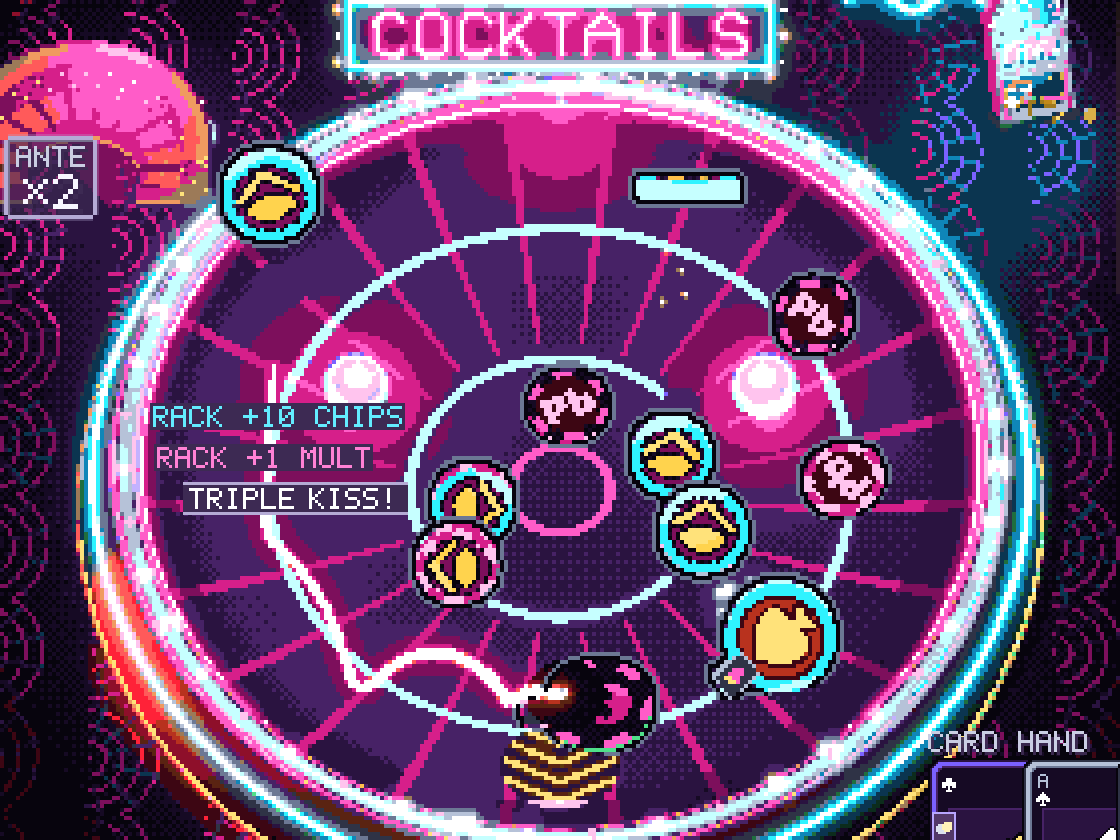 02Neon Lounge
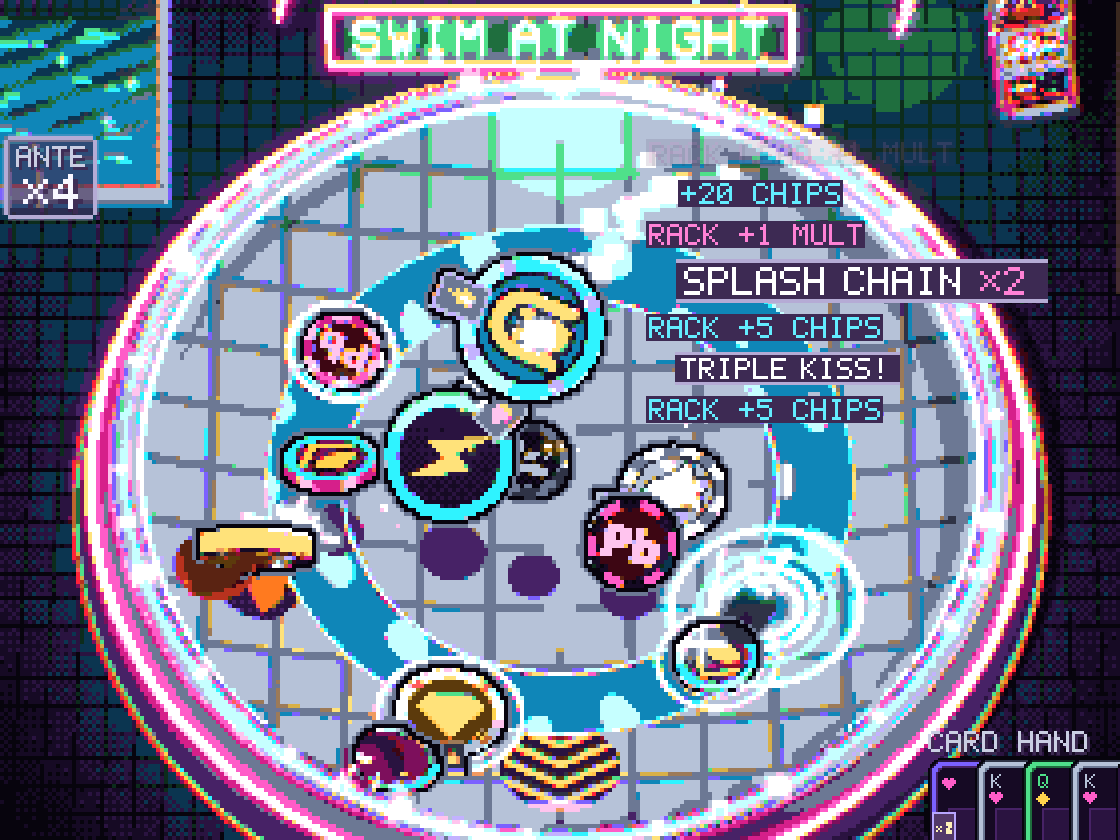 03Poolside Deck
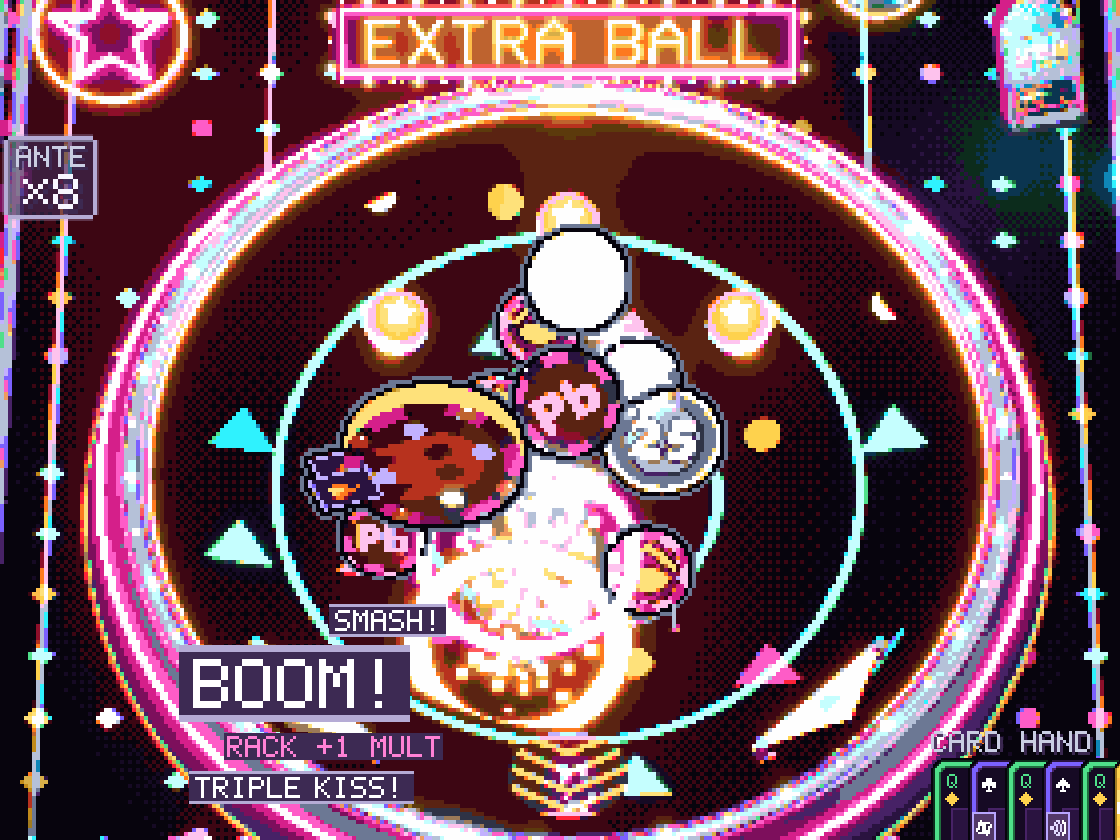 04Pinball Palace
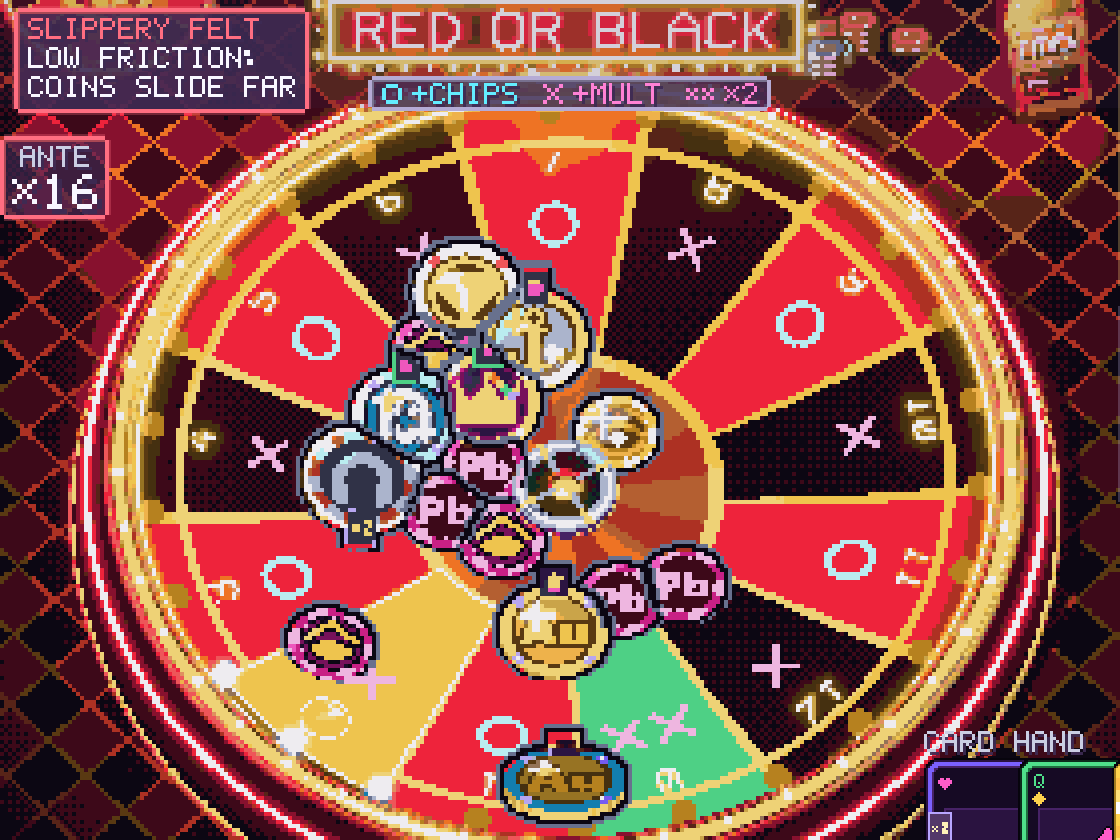 05Roulette Royale
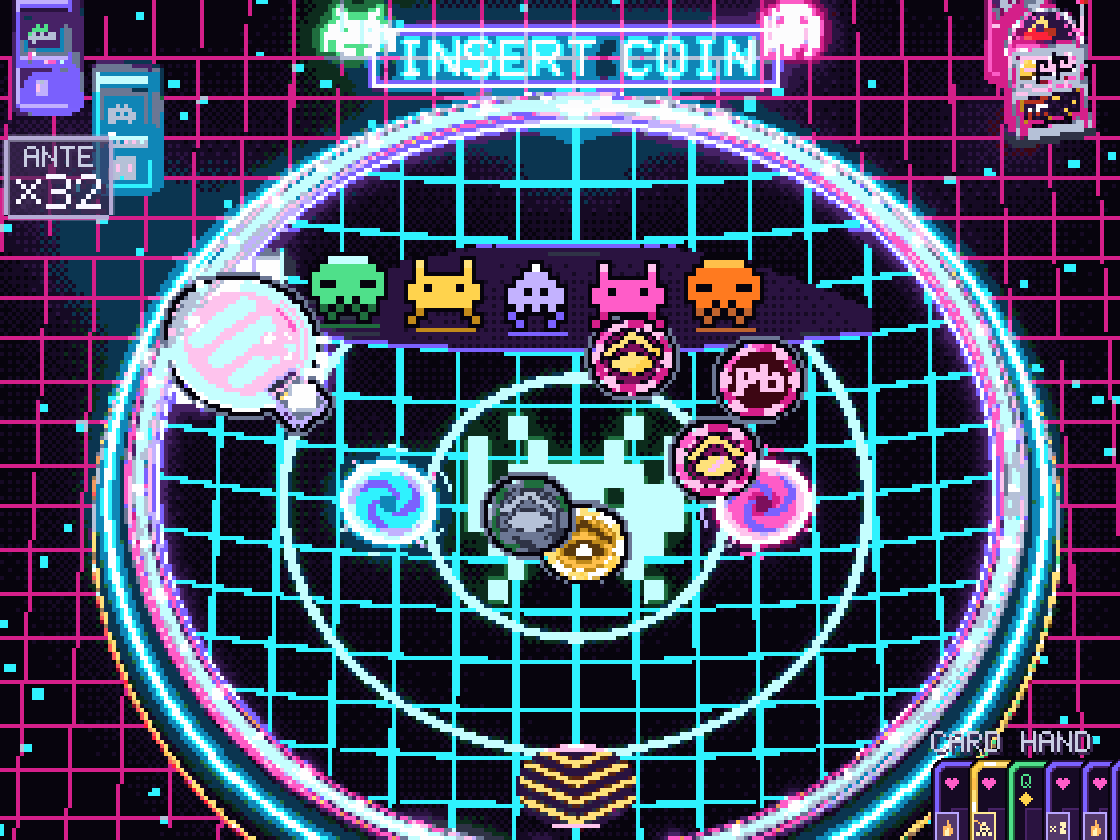 06Arcade Alley
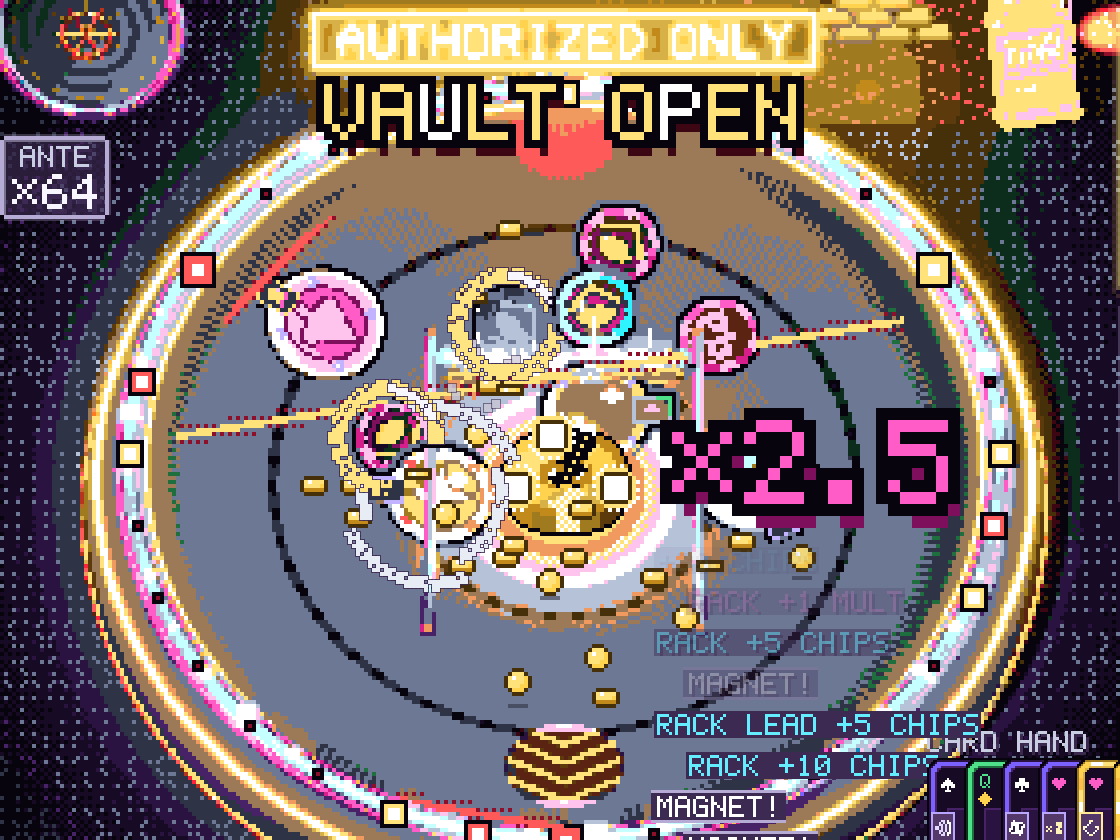 07The Vault
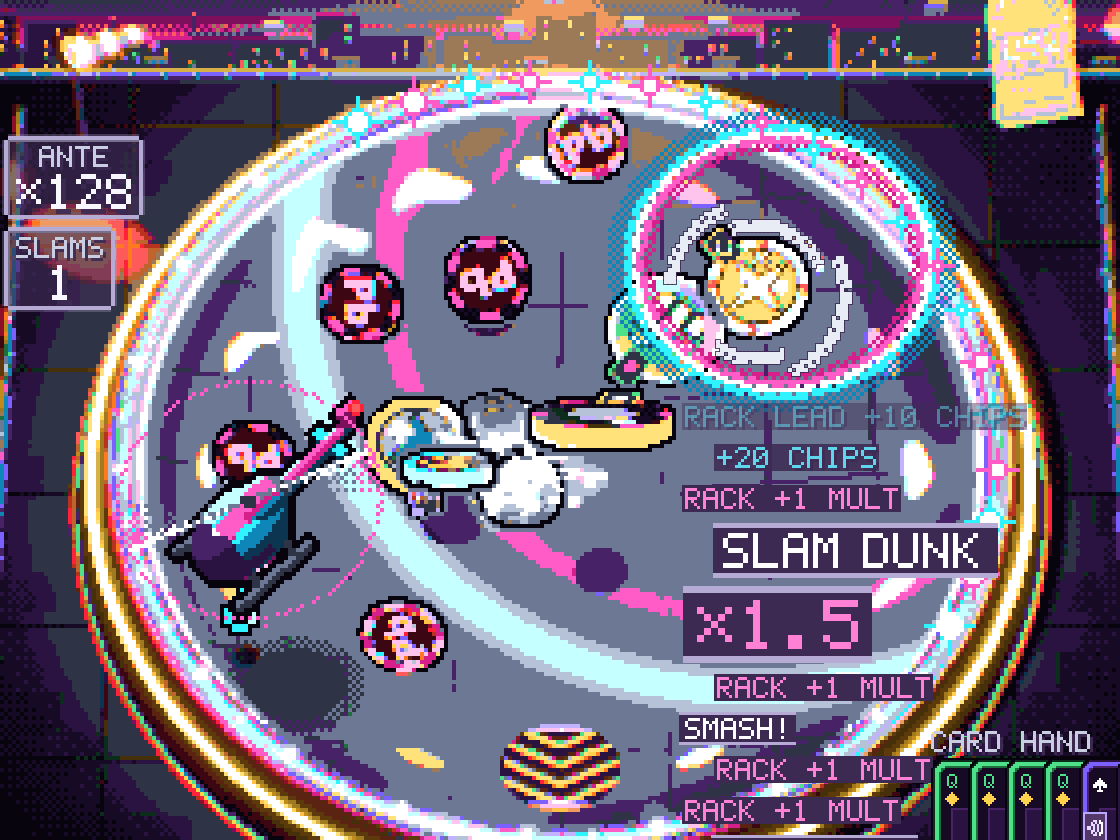 08Skyline Rooftop
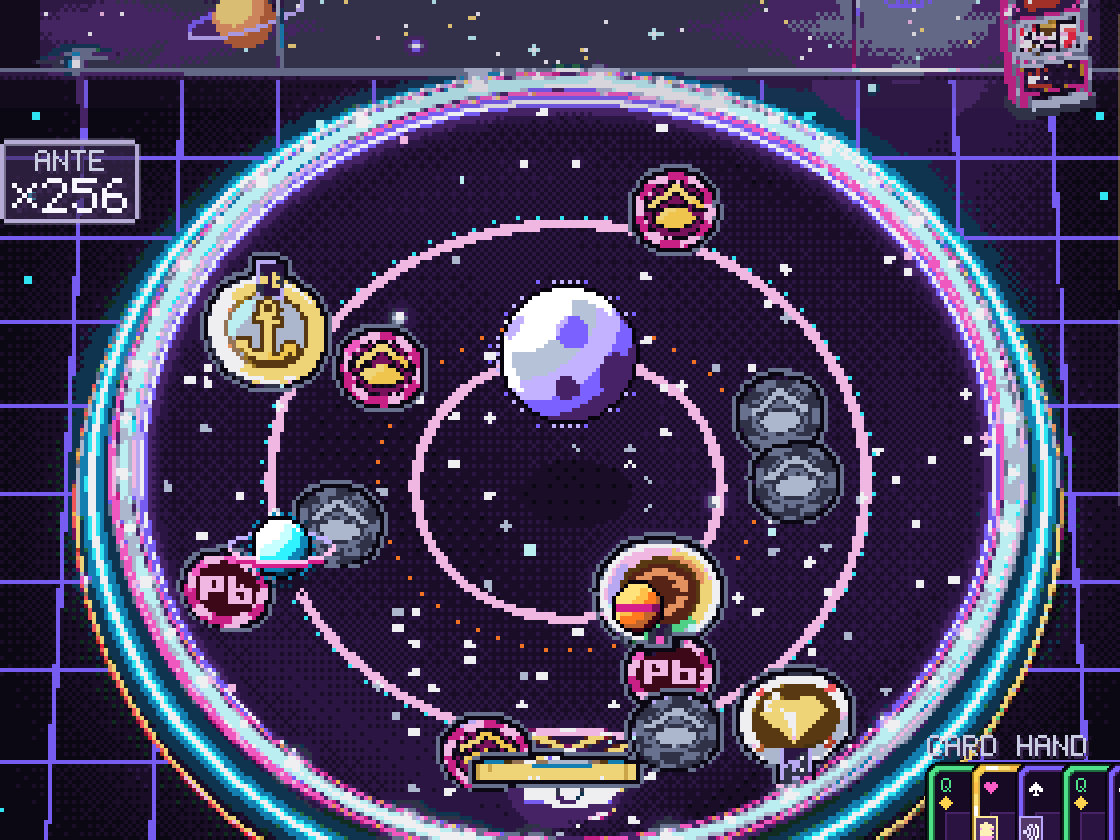 09Orbit '86 Station
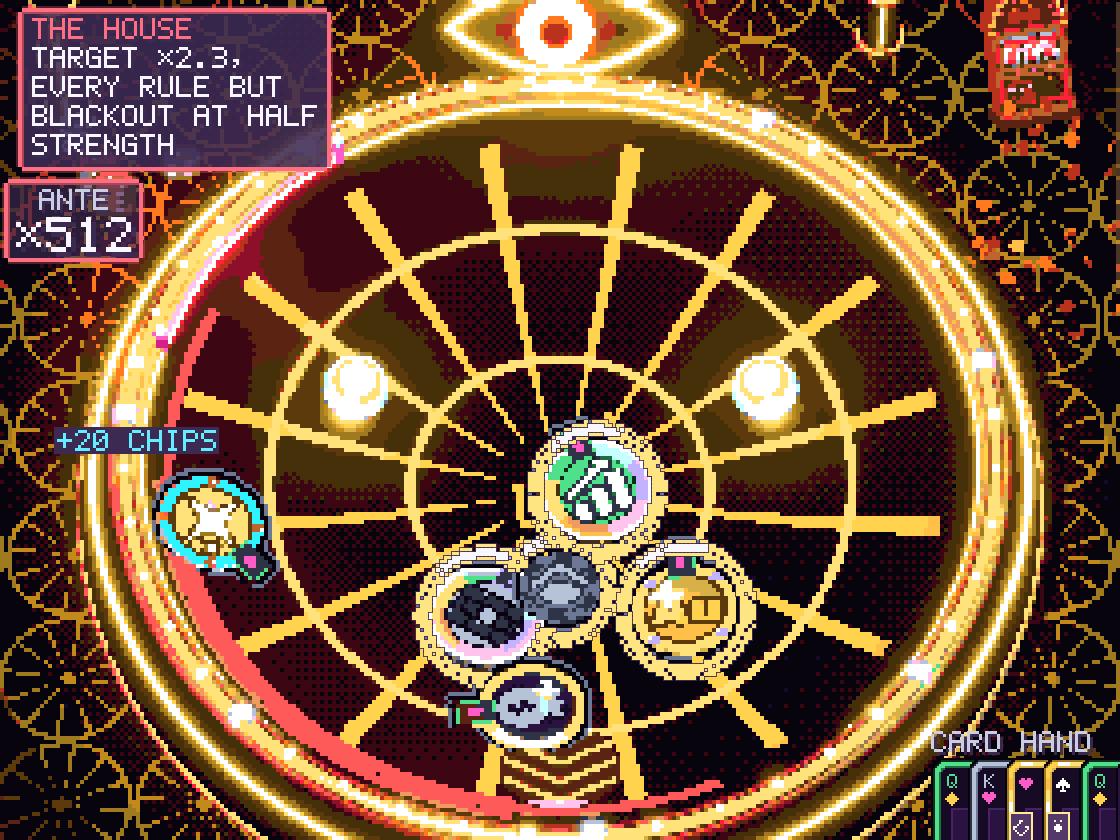 10The House Floor
 +High Roller Lounge
 +The Penthouse
The ten floors in order, then the High Roller Lounge, open every fifth table, and the Penthouse, where After Hours goes on past table 100. -
7.5One system for every screen
In the last full pass I set one system for every menu. Every panel has the same frame: HUD violet with a thin gold rule. Reward screens get a frame of gold bulbs, and danger screens get red. There is one button: a steel outline, a gold fill when it has focus, and red only for actions that destroy something. Key hints always sit bottom left. Pink and cyan stay out of the menus, because they belong to the floors.
Lucky, the host, is part of that system. He is a gold coin in a top hat and a tux, and he looks the same everywhere: in the game, on the store art, on this site. His poses and faces can change, his identity can't, and he never has numbers on his face. I check his poses by silhouette, ever since a raised hand read as a rude gesture.
Between tables you spend your winnings at Lucky's bar, and every fifth table in the High Roller Lounge. All of it is pretend money.
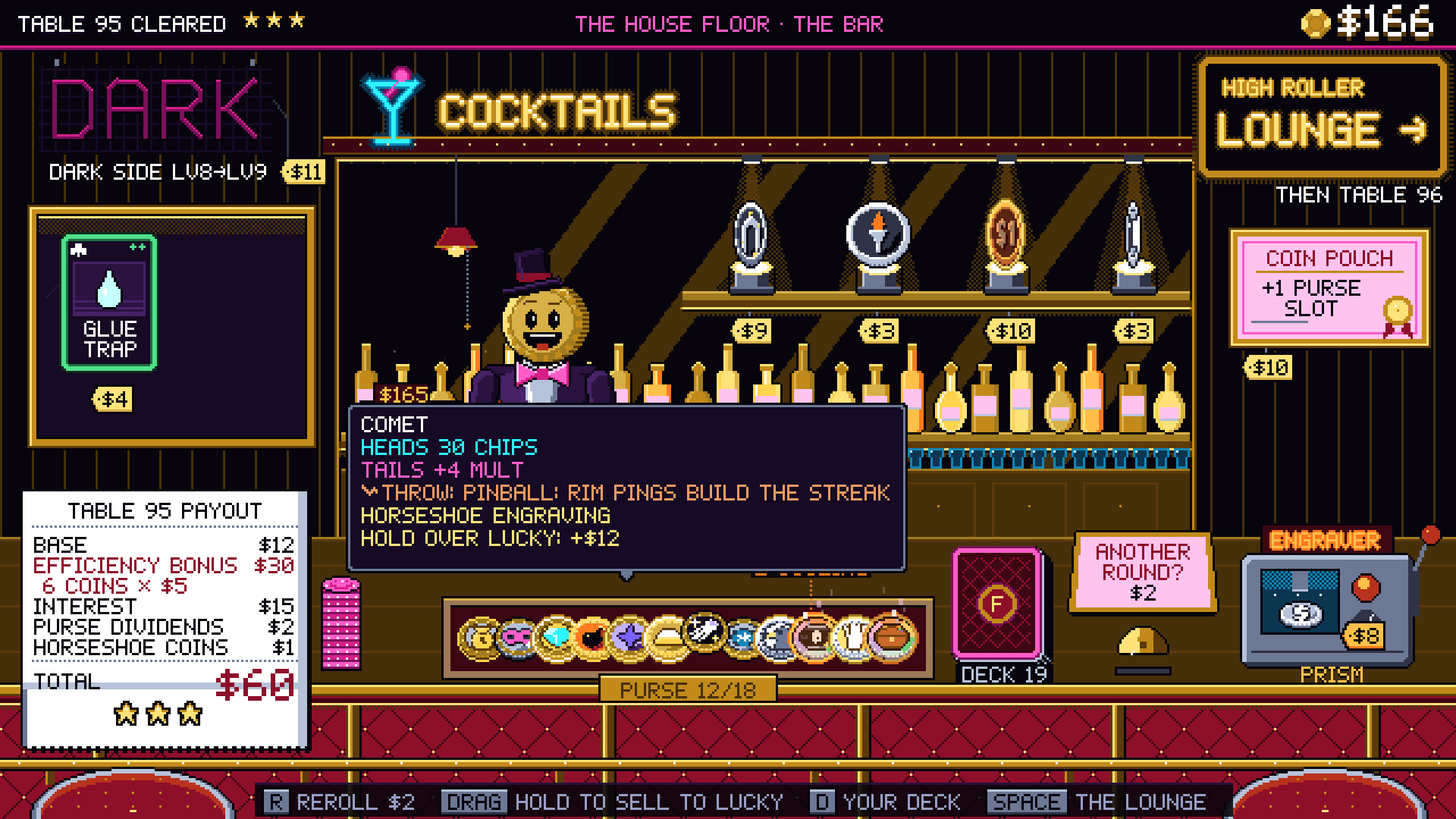
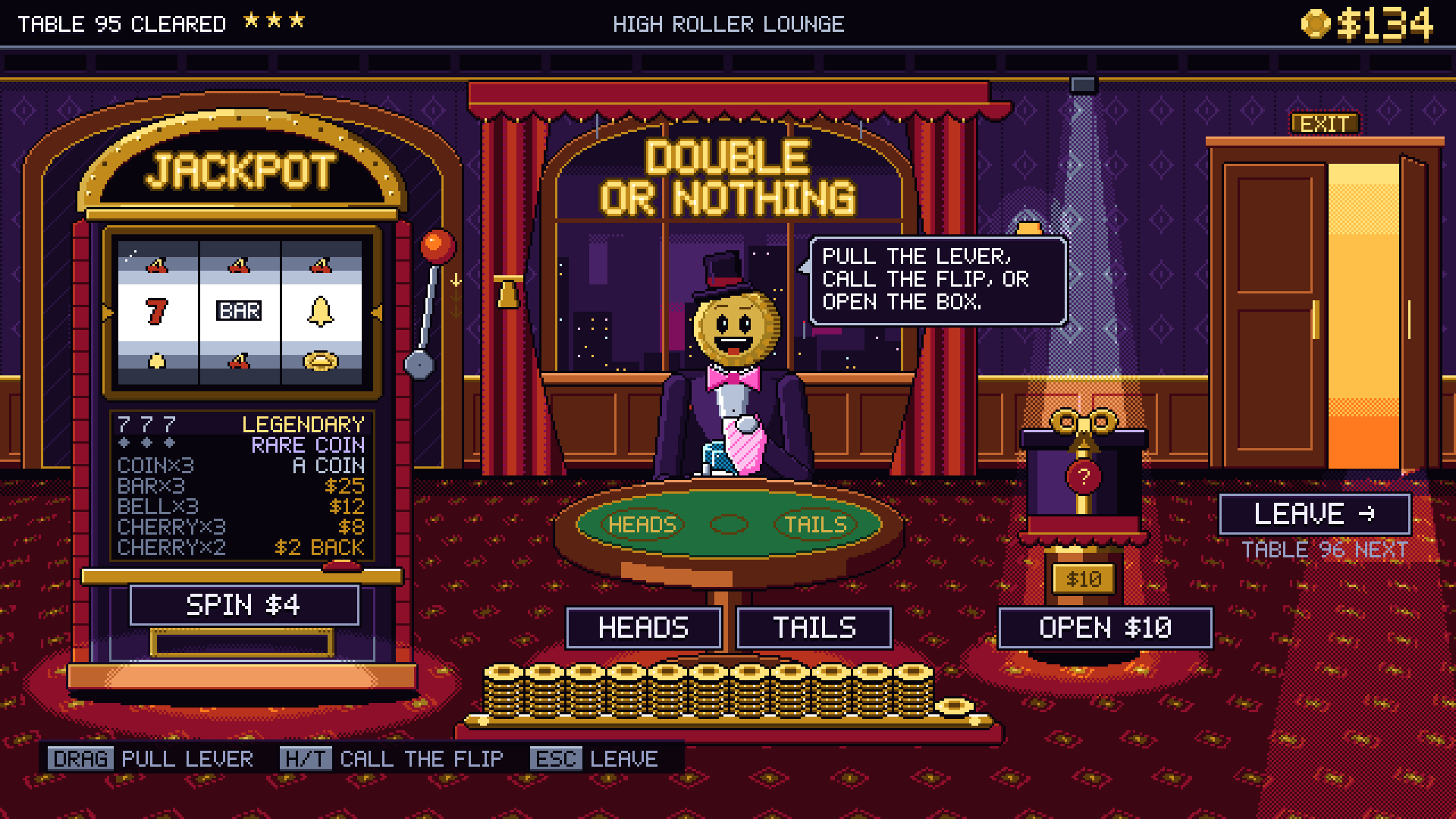
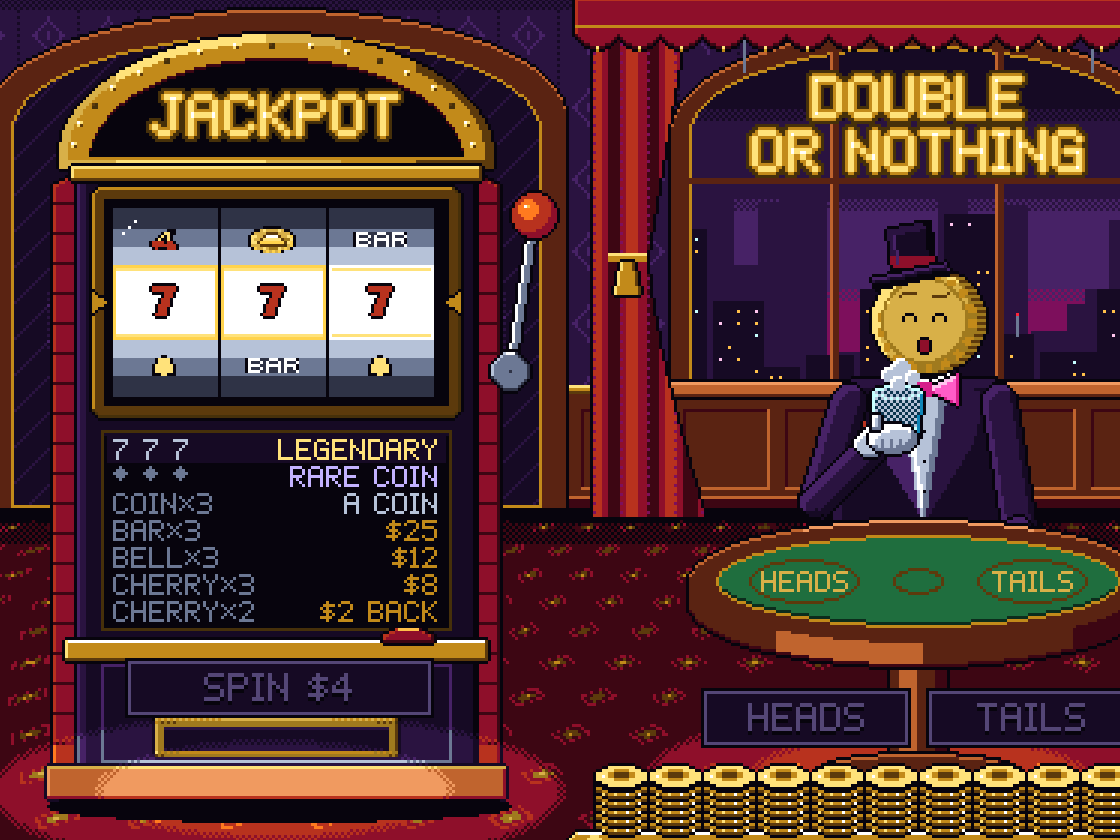
Lucky's bar after table 95, and the High Roller Lounge: a slot machine, Double or Nothing and a mystery box. Every dollar is pretend. -
7.6Show only what a player could play
The marketing is design work too, and it has one rule: real runs only. The footage comes from winning runs, found by an honest balance bot and replayed in the game table by table, with a check that the score matches. The first one gave 33 tables and 227,685 frames of clean footage. The cuts snap to the beat, the captions come from the shot list, and no throw is ever cut short. The hook I cut to is simple: the throw is your hand.
Honest has a precise meaning here. An earlier bot was allowed the helicopter's release on a table's first throw, which the game never allows, so that run was dropped and a new seed replaced it.
The press kit follows the same line: logos, key art, the store capsules, eight screenshots from the run and a frame of every venue. The logo is chrome, with a pink neon glow in its counters, and I judge it at 231 by 87 pixels and on a light background before it ships.
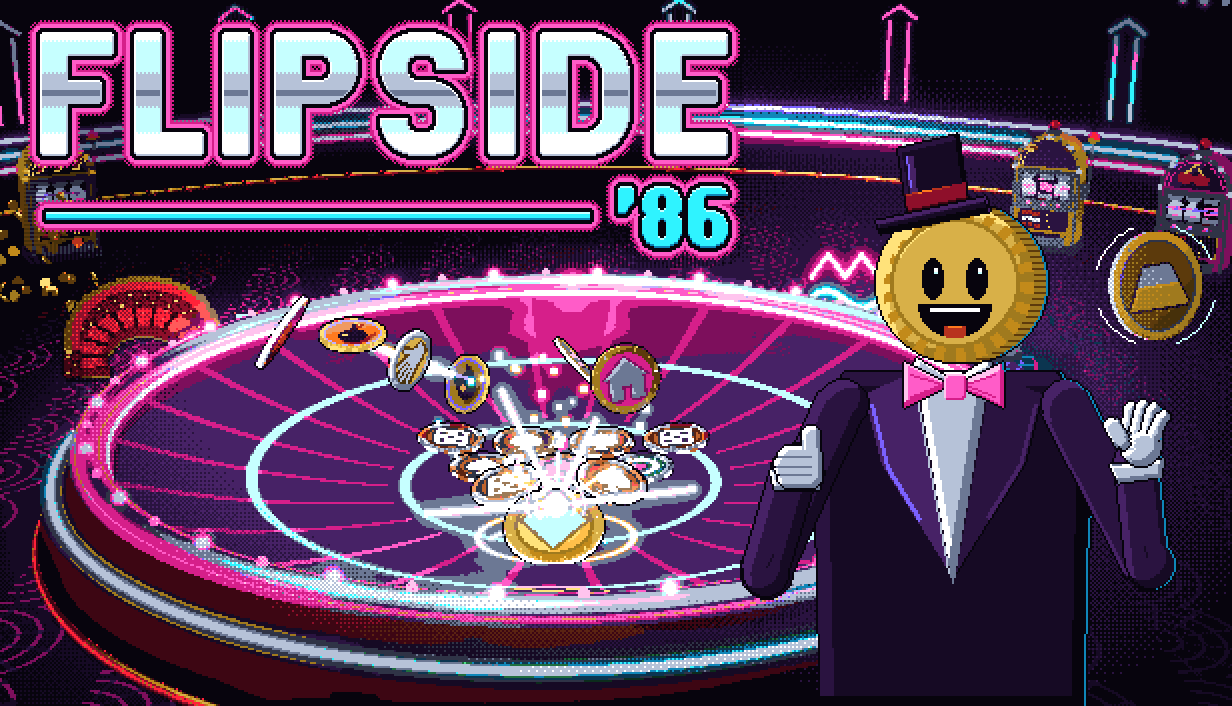
The main capsule from the press kit.
Where it stands
Flipside '86 is in development, for Windows and Steam Deck. The features are frozen, and the latest build is 0.1.23, tagged on 15 November.
It has 45 coins, 39 cards, 18 combos and ten boss tables, eight stakes, a daily run on one seed for everyone, and After Hours for runs that go past table 100.
The rest is on me: playing the reworked floors, a test on Steam Deck hardware, and the store work. Mac and Linux are on hold for now.
It's built in Unreal Engine 5.8 and C++, with the rules in TypeScript as the reference. The music is my own.